
The Quality Upgrade Path of a National Brand
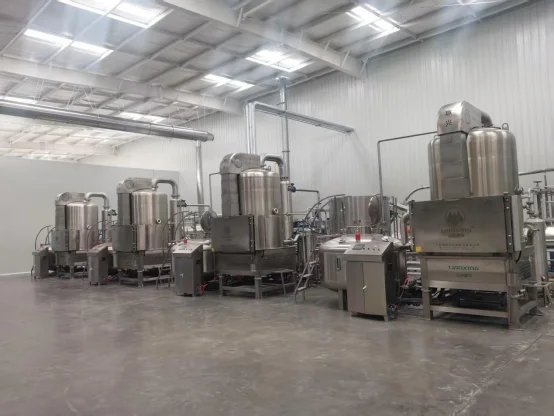
Project Overview: Deployed 6 sets of 300 kg-class vacuum frying systems to achieve large-scale, standardized production of taro strips.
Challenge: The “greasiness” and “unevenness” of starchy snacks
As a well-known domestic brand, Nongxin has near-stringent quality requirements.
Texture and appearance: Taro has a high starch content, and traditional processes very easily cause the finished product to darken and its texture to become dry and hard. Even more troublesome is that its porous structure absorbs oil like a sponge, producing a “rancid taste” that does not meet high-end market standards.
Hygiene challenges of large-scale production: In the face of the concentrated harvest of fresh taro, 24-hour uninterrupted production is required. Ordinary equipment has many hard-to-clean corners, and starch residue is difficult to remove, becoming a hygiene hazard.
Our solution: Finding a balance between “large scale” and “high quality”
Standardized mass production: With 6 machines working in tandem, a single batch processes up to 300 kg, easily absorbing the concentrated raw material supply and minimizing losses.
Clean production: A fully automatic inline oil filtration system removes starch debris from the oil in real time, slowing oil deterioration. The dead-corner-free structural design makes high-pressure water rinsing effortless, perfectly adapting to high-intensity continuous operation.
Customer value:
The finished taro strips are light yellow in color, crispy in texture and not greasy; this not only caters to the consumer trend toward healthy snacks, but also consolidates Nongxin's leading brand position in the domestic market.